Lesson 1 - Charakteristika hybridního pohonného systému
The Act of 11 January 2018 (Dz. Z 2018r., Poz. 177) on electromobility and alternative fuels
Definition
A hybrid vehicle – motor vehicle within the meaning of art. 2 point 33 of the Act of 20 June 1997 "Road Traffic Law", with an electric-diesel drive in which electricity is accumulated by connection to an external power source.
The hybrid drive system is a close cooperation between two drive sources: an internal combustion engine and an electric motor. The basis of the drive is an internal combustion engine supported by an electric motor, and in some situations completely replaced by it.
Hybrid drive system – different energy sources complement each other, giving synergy. The obtained power is greater than it results from a simple sum of component powers of individual units.
A hybrid system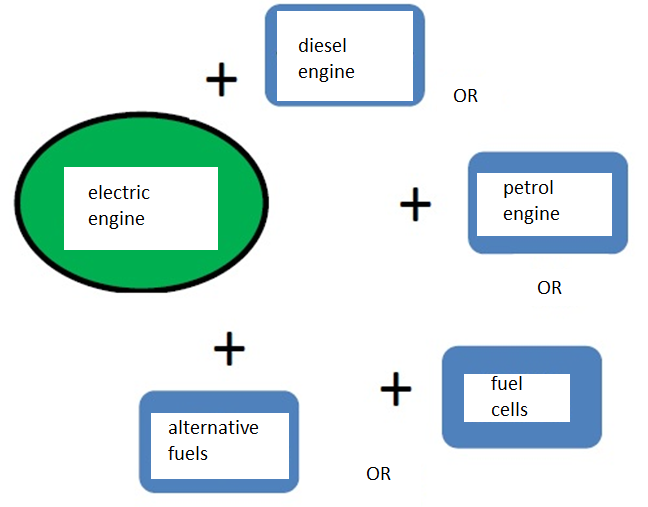
Pic 1 Diagram of a hybrid system
TECHNOLOGY OF HYBRID ENGINES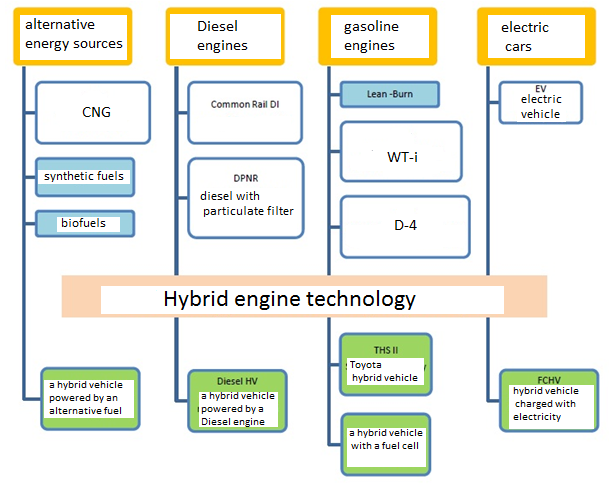
Pic 2 Hybrid engine technology scheme.
Emissions problems can not be solved using only one technology. All engines have advantages and disadvantages.
|
Engine |
Advantages |
Disadvantages |
|
Petrol |
It emits less nitrogen oxides than a diesel engine. It emits trace amounts of micropiles. |
Emission of pollution. High fuel consumption. Too little efficiency. |
|
Diesel |
More economical They emit less carbon dioxide. |
Emission of pollution. High fuel consumption. Too little efficiency. |
|
Electric |
Ecologically clean. |
A vehicle equipped with an electric motor has a short range. Vehicle batteries require frequent recharging. |
The hybrid system is based on the combination of an internal combustion engine and an electric motor. The connected engines support each other. Such a complex drive unit has more advantages and fewer disadvantages than each of the engines separately.
A complex drive unit consists of an internal combustion engine that should emit low emissions and an eco-friendly pure electric motor powered by nickel hybrid batteries. The whole is controlled by a suitable device ensuring optimal use of the power and advantages of both drive sources.
The drive unit cooperating with the electric motor can be powered by gasoline, diesel oil, alternative fuels, and also fuel cells.
An important process of the
hybrid system is the flexible control of the energy stream produced by two
cooperating engines under all driving conditions: acceleration, steady speed
driving, braking phase, city driving with frequent braking and acceleration.
Characteristics of the hybrid drive unit
The summary characterization of the hybrid combination of the internal combustion engine and the electric motor gives a very favourable torque and power curve, similar to the "ideal".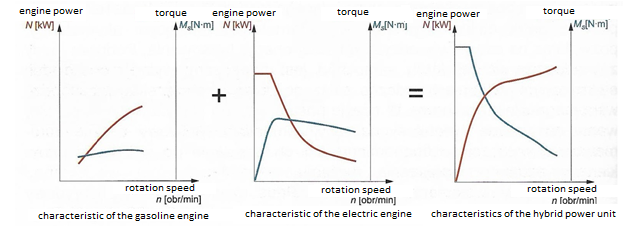
Pic. 3 Characteristics of the Toyota Prius hybrid power unit
Hybrid Synergy Drive (HSD)
The system is used in the latest generations of Toyota hybrid cars. HDS gives good performance, low emissions, pleasure of travelling at low operating costs.
In this case, synergy is the close cooperation between the gasoline and electric engines in order to improve the performance and economy of this system. The electric motor has more power therefore the entire hybrid system works with greater efficiency. This results in improved car performance and contributes to a reduction in fuel consumption.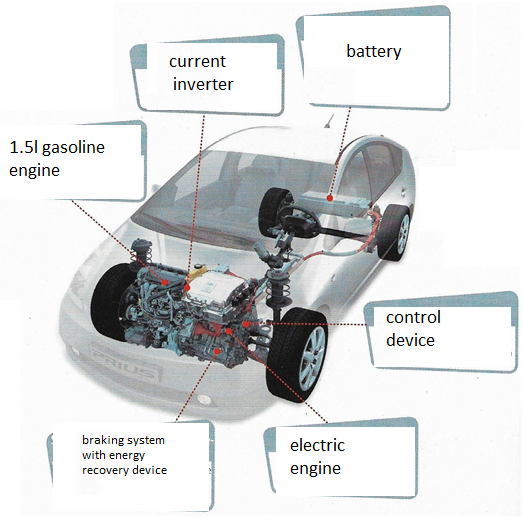
Pic. 4 Toyota Prius Hybrid Synergy Drive System
The advantages of the Hybrid Synergy Drive system:
Ø Excellent performance, good acceleration,
Ø Low fuel consumption of 4.3 liters of fuel per 100 km,
Ø Less exhaust emissions,
Quieter driving, the car can only be driven by an electric motor.
Do you want to start at the last page you saw?